India has one of the most vibrant financial markets in the world. Year after year, millions of new investors enter the space with big dreams and very little hand-holding. Some people have them. Many don’t. It’s not that the market is unfair; they just walked in without knowing the rules of the game.”
Whether you’re a first-time investor wanting to learn the basics, or an experienced trader looking for faster, cheaper alternatives – this guide is for you. We will discuss how the stock trading system works in India, what options are available other than the conventional stock trading platforms, and why more and more traders are turning towards dabba trading as a serious alternative.
How the Indian Stock Market Actually Works
The two big exchanges are the Bombay Stock Exchange (BSE) and the National Stock Exchange (NSE). These are the centres of stock trading in India. These are places where companies list their shares, and buyers and sellers come together to trade them.
When you buy a share, you are buying a small part of the ownership of a company. The price goes up and down depending on supply and demand, how the company is doing, world events, and a dozen other things. Traders buy and sell to make a profit from these price changes. Long-term investors buy shares to profit from the growth of the business over time.
The formal structure — SEBI regulations, exchange fees, broking commissions, STT and settlement cycles — provides a framework, but in doing so, it also creates layers of cost and friction that active traders have to constantly work around.
The Hidden Cost of Working with Old-School Brokers
Here’s the problem most traders run into that they don’t see coming. Conventional broking platforms charge a combination of brokerage charges, Securities Transaction Tax (STT), exchange transaction charges, GST, SEBI turnover fees, and stamp duty. These charges can quietly eat between 0.1% and 0.5% of your trade value on one trade.
For a casual investor who trades only a handful of times a month, that may not seem like much. These hidden costs can quickly add up and kill a strategy that seems to be profitable on paper for high-frequency traders who make dozens of trades a day.
This is the main reason why many active traders have started to look at dabba trading, which is a model that gets rid of all the regulatory burden and lets traders keep more of what they earn.
What is Dabba Trading? Who is using it?
Dabba Trading is a type of trading in which trades are executed outside the formal exchange infrastructure, but at live market prices. Our trades are based on the real market movements, the prices that you see on NSE or BSE, but without the intermediary costs that eat into your margins on each transaction.
The word used to have a laid-back reputation. But today’s platforms are a world away from the unofficial ledgers of old. The digital platforms available today are built with real-time data streaming, advanced charting tools, and secure environments that are as fast, if not faster than, what traditional brokers can provide in terms of speed and quality of execution.
The average user? Retail traders are sick of brokers eating profits, for the professional scalper who needs sub-millisecond execution. You are an Indian forex investor looking to explore the market and looking for the flexibility that comes without the paperwork.
The Modern Trading Platforms – What They Offer
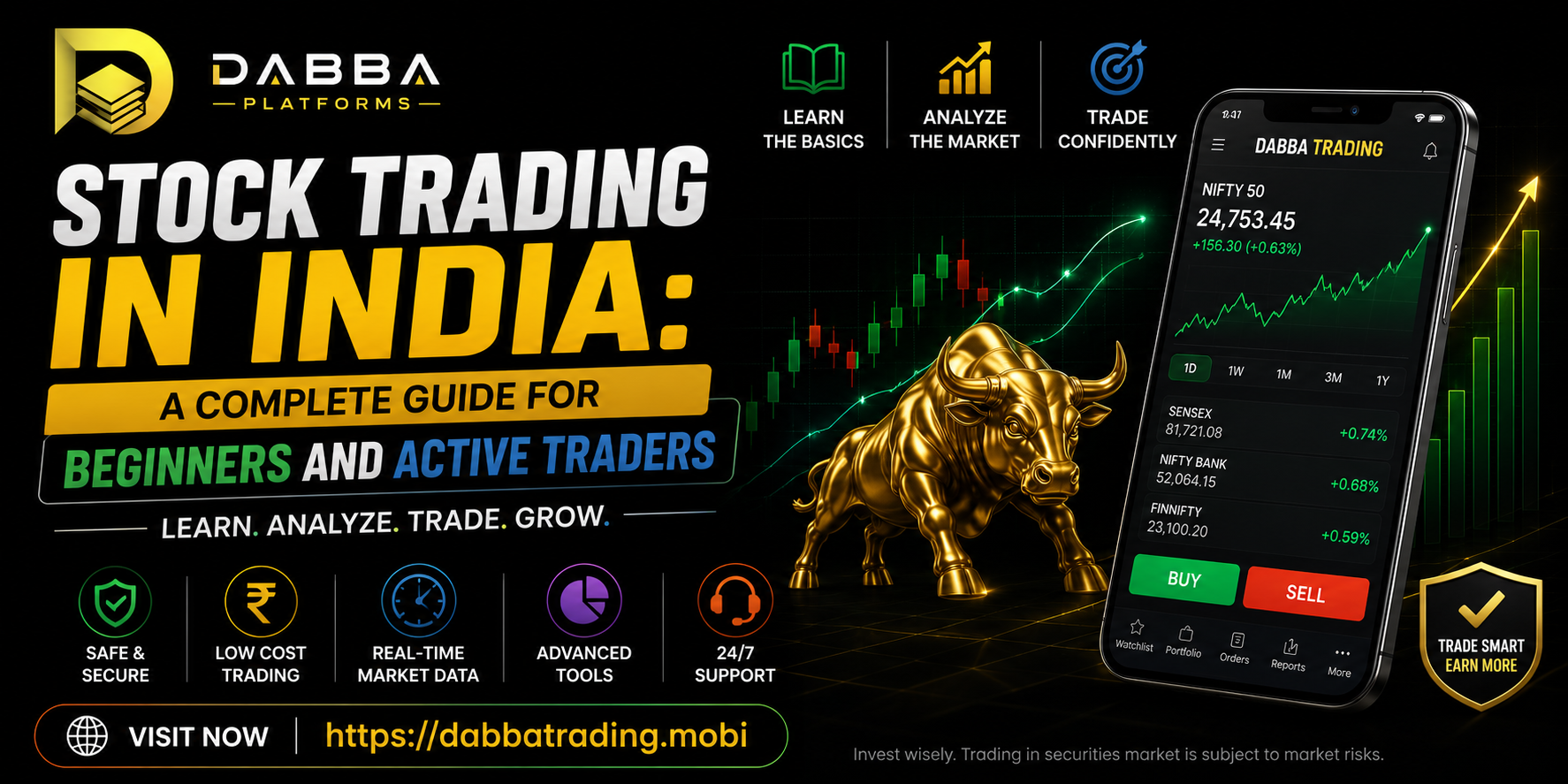
The face of stock trading in India has changed a lot. The newer platforms, especially those targeting active dabba traders, have features that serious market participants actually need:
•Super-fast performance– In trading, milliseconds count. The best platforms will fill your order at the price you see and not a fraction later when the market has already moved.
•With real-time price feeds and analytical tools, live market data gives traders the information they need to make confident decisions, not chase delayed data.
•Dabba platform – No hidden charges, no STT, SEBI charges, exchange fees. You have what you do.
•Expert advice assistance– A good platform doesn’t just give you a terminal and say “Good luck.” They offer strategy consulting, 24/7 support, and use guidance during volatile sessions.
Getting Started Without Getting Lost
Jumping into stock trading in India without a basic framework is the biggest mistake any beginner can make. What you really need before you make your first trade is:
•Know what you are trading -Stocks. Exchange rates. Commodities. Each has its own beat. Its own risk assessment. It’s my own time. When you get started, make sure you don’t confuse the two.
•Know your costs- make sure you know how much each trade you are going to make is going to cost you, whether you are using a traditional broker or a dabba platform.
•Start with a familiar risk– Don’t enter a trade without knowing how you will get out. Most new traders lose money not because they made the wrong analysis, but because they did not know when to get out.
•Select the right platform– The platform you trade on will affect speed of execution, costs, and support. Don’t just pick the most advertised; pick the one that suits how you actually trade.
Why Increasing Numbers of Traders Are Switching
The shift in Indian trading isn’t just about saving money. This is strength. Traders are beginning to learn from years of using traditional broking systems that the ability to execute faster, with less friction and direct market access, is changing the game.
That is exactly the USP of platforms like dabbatrading.mobi. The platform has become a go-to for serious traders across India who want to stop leaving money on the table, with a security-first architecture that protects both data and capital, and has over 15 years of experience in the dabba trading space and over 25,000 active users.
Trade smarter: Visit Dabbatrading.mobi or WhatsApp us at +91-9978858368 to get your trading ID.
FAQ’s
1. What is Dabba Trading? How is it different from Stock Trading in India?
In India, regulators monitor any buying or selling of shares on a recognized exchange. You pay fees to the exchange, and you go through a settlement process. Dabba trading is done on live market prices, but since it is not part of the formal infrastructure, it doesn’t have regulatory overheads like STT and SEBI charges. This makes it a far cheaper way of trading for high-volume and high-frequency traders.
2. Is Dabba Trading Safe?
Your safety lies with the platform you select. Rely on platforms like dabbatrading.mobi to provide best-in-class data protection protocols, secure fund management systems, and transparency. Always do your own research before choosing any trading platform, formal or informal.
3. Is dabba trading good for beginners?
Yeah. Most dabba platforms are made for traders of all experience levels. The trick is to find one that will give you educational resources, strategy consulting, and responsive support so you don’t have to figure everything out yourself in a volatile market.
4. What can be traded on dabba platforms?
India’s most advanced dabba platforms for equities (stocks), forex, and commodities. For example, dabbatrading.mobi provides stock trading in India, dabba online trading, and online forex trading all in one place with live market data and real-time analytics.
5. How to start trading on dabbatrading.mobi?
Getting started is simple. To get your trading ID, sign up on dabbatrading.mobi or contact the team on WhatsApp +91-9978858368. We provide 24/7 support to our new and old users.