
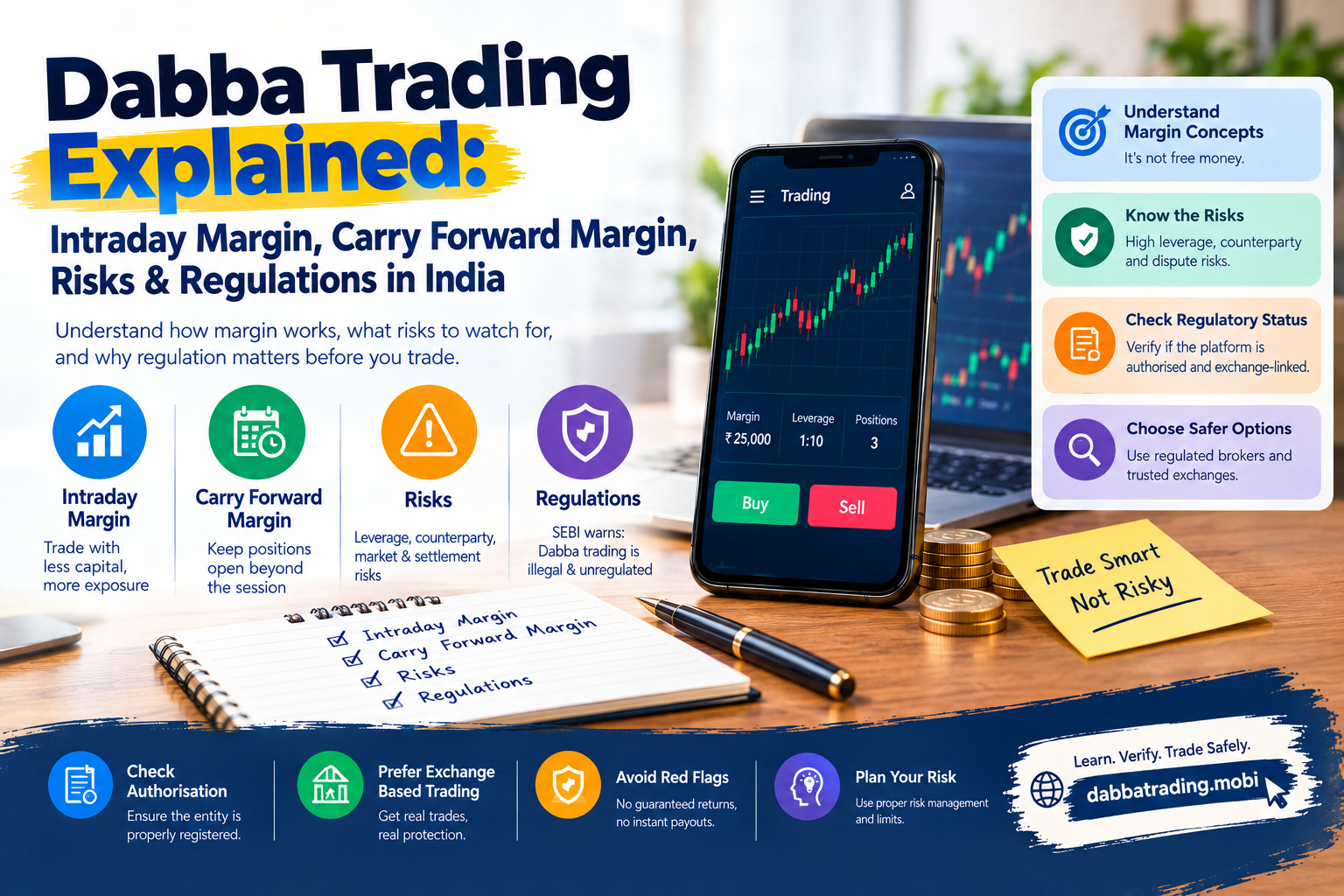
Terms such as intraday margin and carry-forward margin are frequently used when people compare trading services. In the context of dabba trading, these terms can be especially misleading because an advertised margin figure does not mean that the underlying trade is being executed through a recognised exchange.
This guide explains the concepts in simple language and highlights the risks traders should understand before depositing money with an unregistered operator.
What is Dabba Trading Explained and Intraday Margin?
Intraday trading generally means opening and closing a position within the same trading session. Dabba Trading Explained andMargin allows a trader to take a position with less capital than the full value of the position, subject to the rules of the relevant market and intermediary.
For example, if a legitimate intermediary permits a particular level of exposure against available funds, the trader can potentially control a larger position than the cash deposited. The exact margin requirement depends on the product, market conditions and applicable rules.
Dabba operators may advertise much higher intraday leverage. This can make the service appear inexpensive, but higher leverage also means that losses can build quickly.
What Is Carry-Forward Margin?
A carry-forward position is one that remains open beyond the same trading session. Maintaining such a position can require different funding or margin conditions than an intraday position.
The important point is that margin rules are not simply a marketing feature. In regulated markets they are linked to risk-management systems and applicable exchange and regulatory requirements.
When a service promises unusually high carry-forward exposure without explaining the underlying risk, traders should be cautious.
Why Margin Is Not Free Money
A common misunderstanding is that a high margin facility reduces the risk of trading. It does the opposite when position size increases.
Suppose a trader has ₹25,000 and takes exposure of ₹2.5 lakh. A 5% adverse movement in the position represents ₹12,500, which is half of the initial capital. The calculation is simplified, but it shows why leverage can magnify the effect of ordinary market movements.
This is particularly important for beginners who may focus on the amount needed to enter a position rather than the total exposure created.
Dabba Trading and Regulation
SEBI describes dabba trading as illegal and unregulated. In this model, trades are not actually executed on a recognised stock exchange and are instead settled internally by the operator.
This creates a major difference between the advertised margin and genuine exchange-based trading. The customer may see a profit or loss calculation, but there may be no corresponding exchange trade in the customer’s name.
Risks of Intraday Dabba Trading
The first risk is rapid loss because of leverage. The second is counterparty risk: the operator may be responsible for settling the result.
Another concern is dispute resolution. Since the transaction is outside the recognised exchange system, the customer does not have access to the normal exchange grievance mechanism for that trade.
Carry-forward positions create additional uncertainty because money may remain exposed for longer and settlement depends on the operator.
How to Evaluate a Trading Service
Do not judge a platform only by its margin chart or mobile interface. Check whether the entity is authorised, whether trades are executed on a recognised exchange and whether official trade documentation is provided.
Be particularly careful with claims of extremely high leverage, guaranteed returns or instant payouts.
A Better Approach
Traders who want to participate in Indian securities markets should consider regulated brokers and recognised exchanges. They should understand product-specific margin requirements and risk disclosures before trading.
It is also wise to start with a clear risk limit instead of deciding position size from the maximum leverage available.
Final Thoughts
Intraday margin and carry-forward margin can be useful concepts when understood within a regulated trading environment. They become much more dangerous when presented simply as marketing promises by an unregistered operator.
Dabba Trading is not made legitimate by a mobile app, attractive margin plan or fast settlement claim. The critical question is whether the transaction is actually executed through recognised market infrastructure.
For anyone comparing trading platforms in India, legality, transparency and investor protection should come before leverage or promotional benefits.
Regulatory reference: SEBI Investor guidance on Dabba Trading.